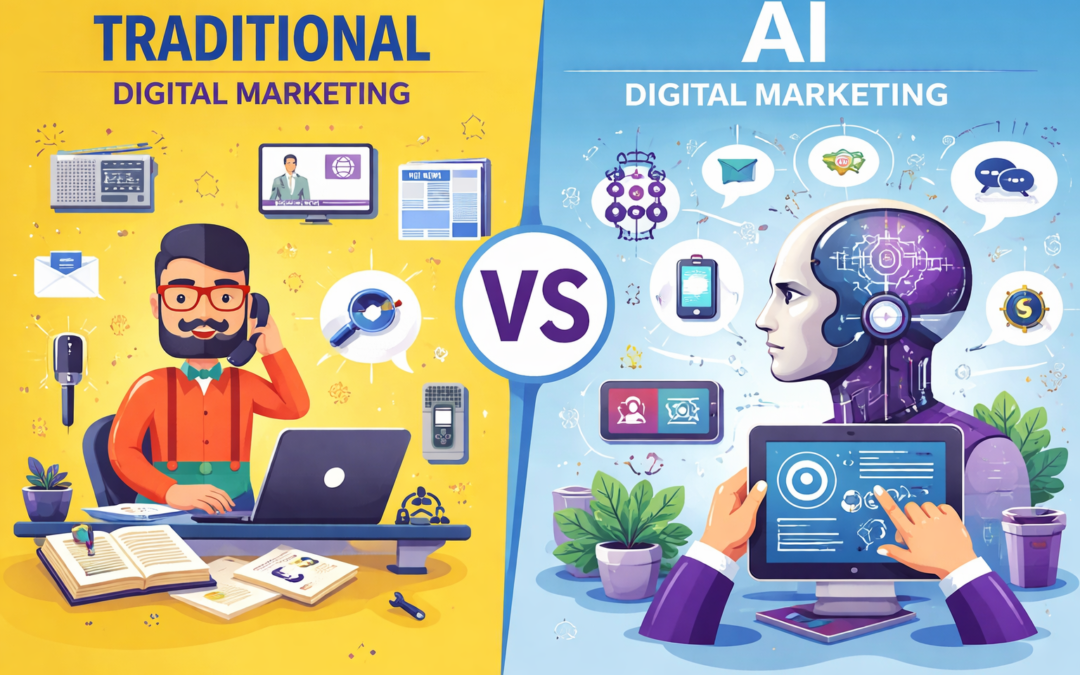
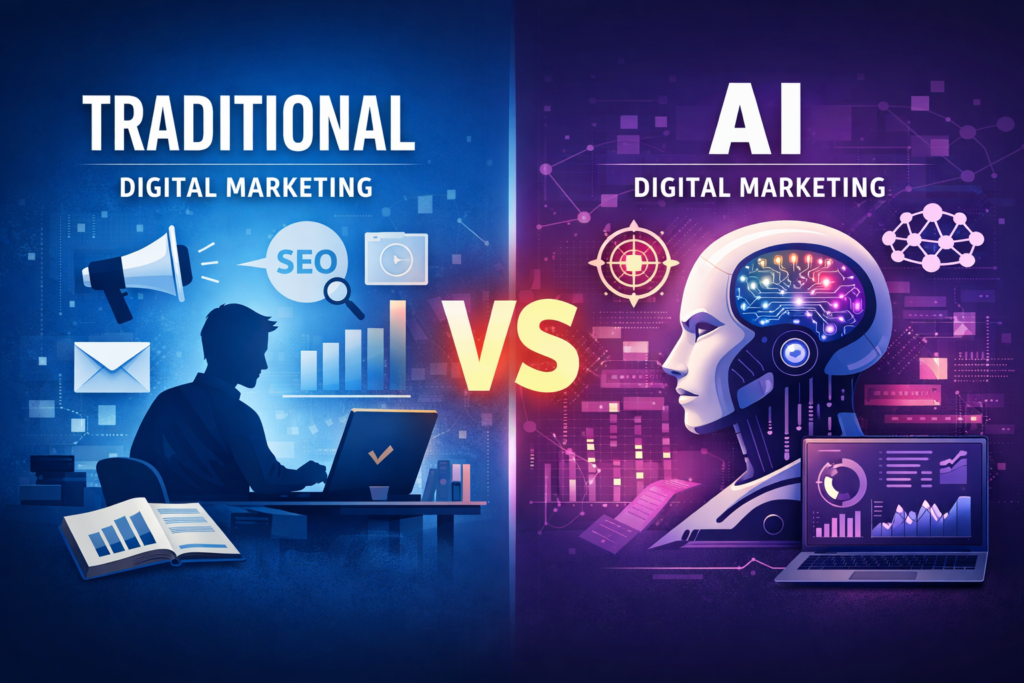
Traditional digital marketing uses manual strategies, human decisions, and fixed campaigns. AI digital marketing uses automation, data, and machine learning to improve results in real time. AI marketing is faster, more personalized, and more scalable, while traditional marketing is still important for creativity and brand building.
Contents
- 1 Traditional vs AI Digital Marketing (Complete Guide)
- 2 What is Traditional Digital Marketing?
- 3 What is AI Digital Marketing?
- 4 Traditional vs AI Digital Marketing: Key Differences
- 5 Advantages of Traditional Digital Marketing
- 6 Disadvantages of Traditional Digital Marketing
- 7 Advantages of AI Digital Marketing
- 8 Disadvantages of AI Digital Marketing
- 9 Industry Insight: Experts Leading the Shift on Traditional vs AI Digital Marketing
- 10 Real-Life Use Cases
- 11 AI Tools Transforming Digital Marketing
- 12 Which One is Better: Traditional vs AI Digital Marketing
- 13 The Hybrid Approach (Best Strategy)
- 14 Future of Digital Marketing
- 15 FAQs (People Also Ask)
- 16 Final Thoughts
Traditional vs AI Digital Marketing (Complete Guide)
Digital marketing is evolving quickly. Businesses that once relied only on manual strategies are now shifting toward AI-powered systems to stay competitive.
Still, traditional digital marketing is not outdated. It continues to play a strong role, especially in storytelling and branding.
In this guide, you will learn the differences between Traditional vs AI Digital Marketing
- What traditional digital marketing is
- What AI digital marketing is
- The key differences
- Pros and cons
- Which approach works best today
What is Traditional Digital Marketing?
Traditional digital marketing is the use of manual and human-driven methods to promote products or services online.
It includes:
- SEO (Search Engine Optimization)
- Social media marketing
- Email campaigns
- Paid advertising
- Content marketing
In this method, marketers:
- Plan campaigns manually
- Analyze data manually
- Optimize based on experience
Example:
A marketer runs ads, waits for results, and then adjusts targeting or creatives based on performance.
What is AI Digital Marketing?
AI digital marketing uses artificial intelligence to automate and improve marketing processes.
It involves:
- Machine learning
- Data analytics
- Automation tools
- Predictive modeling
AI can:
- Analyze huge data quickly
- Predict user behavior
- Personalize content
- Optimize campaigns instantly
Example:
AI tools automatically adjust ads and show them to the right audience without manual input.
Traditional vs AI Digital Marketing: Key Differences
1. Speed
Traditional Marketing: Slow and manual
AI Marketing: Fast and real-time
2. Data Handling
Traditional Marketing: Limited analysis
AI Marketing: Processes massive data easily
3. Personalization
Traditional Marketing: Basic targeting
AI Marketing: Deep personalization using behavior and preferences
4. Decision Making
Traditional Marketing: Based on human judgment
AI Marketing: Based on data and predictions
5. Cost Efficiency
Traditional Marketing: Higher cost due to trial and error
AI Marketing: Better ROI with optimized performance
6. Scalability
Traditional Marketing: Hard to scale
AI Marketing: Easy to scale across multiple campaigns
Advantages of Traditional Digital Marketing
1. Human Creativity
Humans understand emotions better, which helps in storytelling.
2. Strong Branding
Builds long-term brand identity.
3. Full Control
Marketers control every detail.
4. Easy to Start
No complex tools required.
Disadvantages of Traditional Digital Marketing
- Time-consuming
- Limited data insights
- Less accurate
- Higher costs
Advantages of AI Digital Marketing
1. Real-Time Optimization
2. Better Targeting
3. Automation
4. Predictive Analytics
5. Higher ROI
Disadvantages of AI Digital Marketing
- Initial setup cost
- Learning curve
- Less human touch
- Depends on data quality
Industry Insight: Experts Leading the Shift on Traditional vs AI Digital Marketing
The shift from traditional to AI-driven marketing is being shaped by both global experts and emerging professionals.
For example, Neil Patel is widely known for helping businesses understand SEO, content marketing, and data-driven strategies. His work highlights how data and technology are becoming central to modern marketing.
At the same time, professionals like Anu Nivashini, recognized as one of the best AI digital marketers in Coimbatore, are applying these advanced strategies at a practical level. By combining AI tools with creative marketing, they help brands achieve measurable growth, better engagement, and higher conversions.
This mix of global expertise and local execution shows how AI marketing is shaping the future.
Real-Life Use Cases
Traditional Marketing Example
A small business:
- Posts on social media manually
- Runs ads with manual targeting
- Creates blog content
Results:
- Slow growth
- Average engagement
AI Marketing Example
The same business using AI:
- Automates ads
- Personalizes emails
- Uses AI insights
Results:
- Faster growth
- Higher conversions
- Better user experience
AI Tools Transforming Digital Marketing
1. AI in SEO
- Keyword research
- Content optimization
- Search intent analysis
2. AI in Social Media
- Auto scheduling
- Caption generation
- Trend prediction
3. AI in Advertising
- Smart bidding
- Audience targeting
- Performance optimization
4. AI in Email Marketing
- Personalized emails
- Automation workflows
- Behavior-based targeting
Which One is Better: Traditional vs AI Digital Marketing
The answer is clear:
- AI digital marketing is better for speed, performance, and scalability
- Traditional marketing is better for creativity and emotional connection
The Hybrid Approach (Best Strategy)
The most effective strategy is to combine both and not one in Traditional vs AI Digital Marketing
How It Works:
Use AI for:
- Data analysis
- Automation
- Optimization
Use humans for:
- Creativity
- Storytelling
- Branding
Example:
AI finds the right audience →
Human creates content →
AI optimizes delivery →
Result: Higher conversions
Future of Digital Marketing
The future is already here.
In the coming years:
- AI will dominate marketing processes
- Personalization will increase
- Voice search will grow
- Automation will expand
However, human creativity will always remain important regardless of traditional and ai digital marketing.
Key Takeaways
- Traditional marketing is manual and slower
- AI marketing is fast and data-driven
- AI improves targeting and ROI
- Traditional marketing builds strong brands
- A hybrid approach gives the best results
FAQs (People Also Ask)
1. What is Traditional vs AI Digital Marketing?
Traditional marketing uses manual strategies, while AI marketing uses automation and data.
2. Is AI marketing better than traditional marketing?
AI marketing is better for performance, but traditional marketing is still important for branding.
3. Can small businesses use AI marketing?
Yes. Many AI tools are affordable and easy to use.
4. Will AI replace digital marketers?
No. AI supports marketers but does not replace human creativity.
5. What are examples of AI in marketing?
Chatbots, automated ads, predictive analytics, and personalized emails.
6. Why is AI important in marketing?
It improves efficiency, reduces cost, and increases ROI.
7. What is a hybrid marketing strategy?
It combines AI tools with human creativity for better results.
Final Thoughts
Digital marketing is no longer just about effort. It is about smart execution.
AI is helping businesses grow faster, but human creativity is what builds real connections.
To succeed today, focus on:
- Data-driven decisions
- Personalized experiences
- Strong storytelling
That is the key to winning in modern digital marketing.