
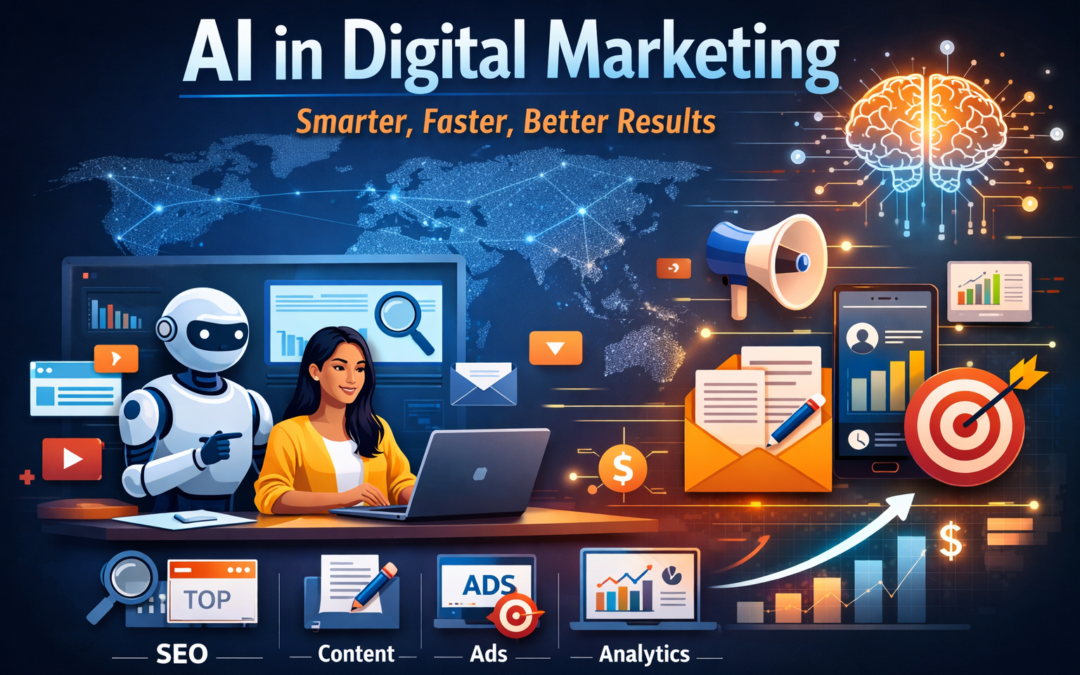
AI in digital marketing means using smart technology to understand customer behavior, create content, automate tasks, and improve marketing results. It helps businesses reach the right audience, at the right time, with the right message—faster and more accurately than traditional methods.
Contents
- 1 Introduction
- 2 What is AI in Digital Marketing?
- 3 Why AI is Important in Digital Marketing
- 4 How AI is Used in Digital Marketing
- 5 Key Benefits of AI in Digital Marketing
- 6 Types of AI Technologies Used in Marketing
- 7 Popular AI Tools for Digital Marketing
- 8 AI and SEO: A Powerful Combination
- 9 AI in Content Marketing
- 10 AI in Social Media Marketing
- 11 AI in Paid Advertising
- 12 Challenges of AI in Digital Marketing
- 13 How to Use AI in Your Digital Marketing Strategy
- 14 Future of AI in Digital Marketing
- 15 Best Practices for Using AI in Marketing
- 16 AI vs Traditional Digital Marketing
- 17 Real-World Examples of AI in Marketing
- 18 FAQs (People Also Ask)
- 19 Conclusion
Introduction
Digital marketing has changed a lot in the past few years. What once needed large teams and long hours can now be done faster with the help of artificial intelligence (AI). Today, AI is not just a tool—it is becoming the backbone of modern marketing.
From writing content to running ads and predicting customer behavior, AI is helping businesses grow in smarter ways. Whether you run a small business or manage a large brand, understanding AI in digital marketing can give you a strong advantage.
This guide explains everything in simple terms. You will learn what AI is, how it works in marketing, its benefits, tools, strategies, and what the future looks like.
What is AI in Digital Marketing?
AI in digital marketing is the use of machine learning, data analysis, and automation to improve marketing performance.
In simple words, AI helps marketers:
- Understand customer behavior
- Create better content
- Automate repetitive tasks
- Make smarter decisions
AI systems learn from data. The more data they process, the better they become.
Why AI is Important in Digital Marketing
1. Saves Time and Effort
AI can automate tasks like email sending, ad optimization, and reporting. This allows marketers to focus on strategy.
2. Improves Accuracy
AI analyzes large amounts of data quickly and finds patterns that humans might miss.
3. Better Customer Experience
AI helps deliver personalized content, which makes customers feel understood.
4. Higher ROI
With better targeting and smarter decisions, businesses get more value from their marketing budget.
How AI is Used in Digital Marketing
1. Content Creation
AI tools can generate:
- Blog posts
- Social media captions
- Product descriptions
- Email campaigns
These tools save time and help maintain consistency.
2. Search Engine Optimization (SEO)
AI helps improve SEO by:
- Finding the right keywords
- Optimizing content structure
- Analyzing competitors
- Suggesting improvements
AI also helps optimize content for voice search and AI answer engines.
3. Chatbots and Customer Support
AI-powered chatbots can:
- Answer customer questions
- Provide product recommendations
- Handle support queries 24/7
This improves user experience and reduces workload.
4. Email Marketing
AI can:
- Personalize emails
- Predict best sending times
- Improve open and click rates
5. Social Media Marketing
AI helps:
- Schedule posts
- Analyze engagement
- Suggest content ideas
- Track trends
6. Paid Advertising
AI improves ads by:
- Targeting the right audience
- Adjusting bids automatically
- Testing multiple versions
- Increasing conversions
7. Predictive Analytics
AI can predict:
- Customer behavior
- Buying patterns
- Future trends
This helps businesses plan better strategies.
Key Benefits of AI in Digital Marketing
Personalization at Scale
AI can show different content to different users based on their behavior.
Faster Decision Making
AI processes data instantly and provides insights.
Cost Efficiency
Automation reduces the need for large teams.
Better Customer Insights
AI tracks user actions and provides valuable data.
Increased Conversions
Better targeting leads to more sales.
Types of AI Technologies Used in Marketing
Machine Learning
Helps systems learn from data and improve over time.
Natural Language Processing (NLP)
Allows AI to understand and generate human language.
Computer Vision
Helps analyze images and videos.
Deep Learning
Advanced form of machine learning for complex tasks.
Popular AI Tools for Digital Marketing
Content and Writing Tools
- Chat-based AI tools
- Copywriting assistants
SEO Tools
- Keyword research platforms
- Content optimization tools
Social Media Tools
- Scheduling platforms
- Analytics dashboards
Email Marketing Tools
- Automation platforms
- Personalization engines
Ad Optimization Tools
- Smart bidding systems
- Audience targeting tools
AI and SEO: A Powerful Combination
AI is changing how SEO works.
Smarter Keyword Research
AI finds keywords based on user intent, not just search volume.
Content Optimization
AI suggests headings, structure, and readability improvements.
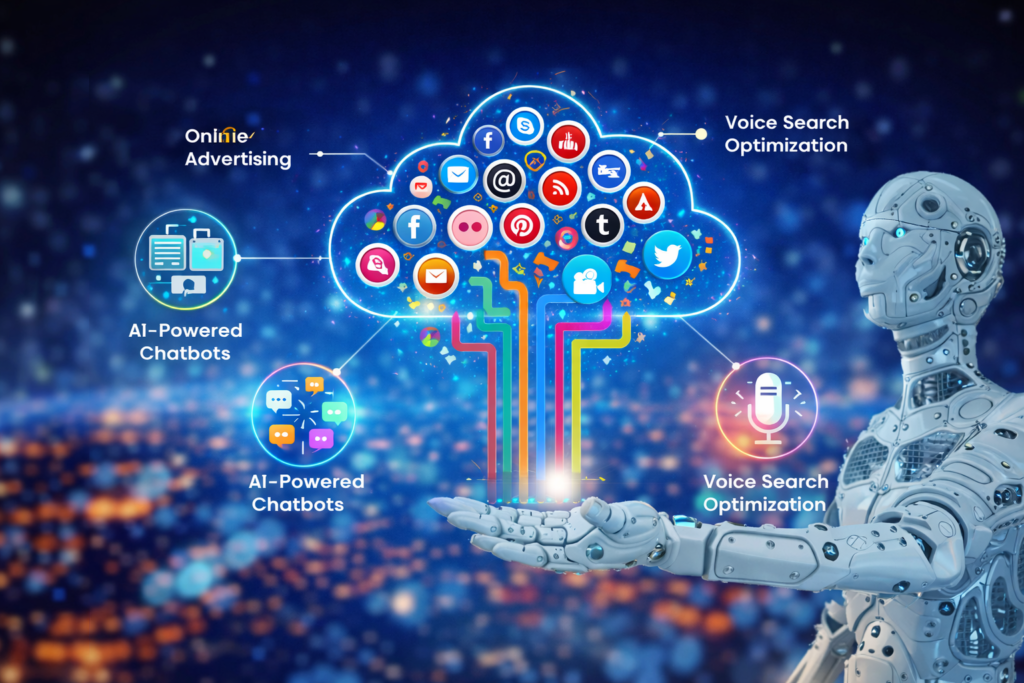
Voice Search Optimization
AI helps create content that answers spoken queries.
Semantic SEO
AI understands context, meaning, and relationships between words.
AI in Content Marketing
AI helps create high-quality content faster.
Idea Generation
AI suggests trending topics and ideas.
Content Writing
AI drafts articles, blogs, and scripts.
Content Optimization
AI improves readability, structure, and SEO.
Content Distribution
AI helps share content at the right time on the right platform.
AI in Social Media Marketing
Trend Analysis
AI tracks trending topics and hashtags.
Audience Insights
AI analyzes user behavior and preferences.
Automated Posting
AI schedules posts for maximum engagement.
Performance Tracking
AI measures likes, shares, and comments.
AI in Paid Advertising
AI makes advertising more effective.
Smart Targeting
AI identifies the best audience segments.
Budget Optimization
AI adjusts spending for better results.
Ad Testing
AI tests multiple ad versions and selects the best one.
Real-Time Adjustments
AI updates campaigns instantly based on performance.
Challenges of AI in Digital Marketing
Data Privacy Concerns
Handling user data responsibly is important.
High Initial Cost
Some AI tools can be expensive.
Learning Curve
Marketers need to understand how to use AI tools.
Dependence on Data
AI works best with large amounts of data.
How to Use AI in Your Digital Marketing Strategy
Step 1: Set Clear Goals
Decide what you want to achieve.
Step 2: Choose the Right Tools
Pick tools based on your needs.
Step 3: Start Small
Begin with one area like content or email marketing.
Step 4: Analyze Results
Track performance and improve.
Step 5: Scale Gradually
Expand AI use as you grow.
Future of AI in Digital Marketing
AI will continue to grow and become more advanced.
Hyper-Personalization
Marketing will become more tailored to each user.
Voice and Visual Search
More users will search using voice and images.
AI-Generated Content
Content creation will become faster and smarter.
Predictive Marketing
AI will predict customer needs before they arise.
Best Practices for Using AI in Marketing
- Use AI as a support tool, not a replacement
- Always review AI-generated content
- Focus on user experience
- Keep learning and updating your skills
- Follow data privacy guidelines
AI vs Traditional Digital Marketing
| Feature | Traditional Marketing | AI Marketing |
|---|---|---|
| Speed | Slow | Fast |
| Data Analysis | Limited | Advanced |
| Personalization | Basic | Highly personalized |
| Cost | Higher long-term | Cost-efficient |
| Accuracy | Moderate | High |
Real-World Examples of AI in Marketing
E-commerce
AI recommends products based on browsing history.
Streaming Platforms
AI suggests shows based on viewing behavior.
Email Campaigns
AI personalizes subject lines and content.
FAQs (People Also Ask)
What is AI in digital marketing in simple terms?
AI in digital marketing means using smart tools to automate tasks, analyze data, and improve marketing results.
How does AI help in marketing?
AI helps by saving time, improving targeting, personalizing content, and increasing conversions.
Is AI replacing digital marketers?
No, AI supports marketers. It handles repetitive tasks while humans focus on creativity and strategy.
What are the best AI tools for marketing?
Popular tools include content generators, SEO platforms, email automation tools, and ad optimization systems.
Can small businesses use AI in marketing?
Yes, many AI tools are affordable and easy to use for small businesses.
How does AI improve SEO?
AI helps with keyword research, content optimization, and understanding user intent.
What is the future of AI in digital marketing?
The future includes more personalization, predictive analytics, and advanced automation.
Conclusion
AI in digital marketing is not just a passing trend—it is shaping the future of how businesses connect with people. It helps brands work faster, make smarter decisions, and create highly personalized experiences that truly matter to customers.
As AI continues to evolve, marketers who adapt early will have a strong advantage. The key is to use AI as a tool to support creativity, not replace it. When human ideas and AI technology work together, the results can be powerful.
Professionals like Anu Nivashini are leading this transformation by combining smart AI strategies with practical marketing knowledge. Globally, experts like Neil Patel have also shown how data-driven and AI-powered approaches can drive real growth.
In the end, success in digital marketing will belong to those who learn, adapt, and use AI in the right way.